An Eye for Art Focusing on Great Artists and Their Work Paperback ââ“ by National Gallery of Art
| Galeri Nasional Indonesia | |
 | |
| Location within Jakarta | |
| Established | May 8, 1999 |
|---|---|
| Location | Jl. Medan Merdeka Timur fourteen, 10110, Republic of indonesia |
| Coordinates | half dozen°10′43″Due south 106°50′00″Due east / 6.178529°S 106.833276°E / -six.178529; 106.833276 |
| Collection size | A collection of 1770 fine arts |
| Managing director | Tubagus Andre Sukmana (2005-now)[1] |
| Curator | Chiliad. Agus Burhan, Inda C. Noerhadi, Rizki A. Zaelani, Kuss Indarto[1] |
| Public transit access |  Gambir GambirTransjakarta feeder and angkot: Stasiun Gambir |
| Website | www.galeri-nasional.or.id |
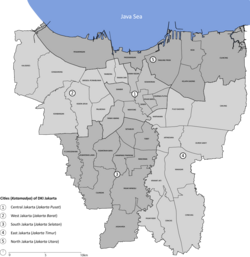

The National Gallery of Indonesia is an art gallery and museum in Jakarta, Indonesia. The National Gallery of Indonesia has existed as a cultural establishment in the field of visual arts since May 8, 1999. The institution plays an important part in expanding public'south awareness of artworks through preservation, development and exploitation of the visual arts in Indonesia.[2]
History [edit]
Educational circuitous [edit]

Lyceum of the CAS, now Gedung B of the National Gallery of Republic of indonesia.
The original address of the complex was Koningsplein Oost No. 14, Batavia. The main building (Gedung A) was built in 1817 past Yard.C. Van Rijk as an Indische Woonhuis (Indies residence) in a Dutch Indies colonial style. The materials for the construction were taken from the remains of Kasteel Batavia.[3]
In 1900, the complex was converted into a HBS educational institution known equally Carpentier Alting Stichting (CAS) nether the authority of the Dutch Protestant pastor and prominent Freemason Albertus Samuel Carpentier Alting (1837–1915). The former Indies residence (Gedung A) were converted into a female dormitory edifice, while several buildings were added to better the facility of the school: a lyceum or master school (1902, at present Gedung B of the National Gallery); a MULO or junior high schoolhouse; and a HBS or senior high school.[iv]
Later independence in 1945, the CAS remained operational to serve Djakarta's large remaining white settler community, although the Indonesian government forced the school to admit students from all races.
In 1955, the Indonesian regime forbade all activities related to the Dutch colonial administration. The educational establishment were placed under the potency of Raden Saleh Foundation, which connected the activities of CAS and remained nether the auspices of the Freemasonry.[3]
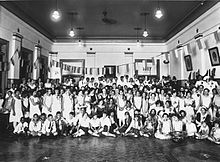
In 1961, all Dutch students and teachers of CAS were expelled by Indonesian authorities, on which year the school was abolished and its premises turned into SDN 01 (Land Chief School No. 1) and Sekolah Menengah Atas seven, "Senior High School 7"[4] [v] In 1962, the military authorities issued a Decision Letter of the alphabet which is signed by President Sukarno which banned Freemasonry in Indonesia. As a result, the Raden Saleh Foundation was disbanded, and the school was taken over by the Section of Pedagogy and Culture of the Republic of Indonesia.[iii]
In 1965, at the fourth dimension of high security threat afterward 30 September Incident, the principal building was used as the headquarters of the Youth and Student Command Unit (Komando Kesatuan Pemuda dan Pelajar Republic of indonesia or KAPPI) that held demonstrations demanding the disbanding of The Indonesian Communist Political party.[3]
In one case the security situation has improved, the building was used by the Indonesian Ground forces (Tentara Nasional Indonesia Angkatan Darat or TNI/AD) every bit Headquarters for the Jayasakti Infantry Brigade nether the auspices of the Jakarta Raya V Military Command (Komando Daerah Militer Five Jakarta Raya: Kodam Jaya).[3]
In 1981, based on a telegram from the Army Chief of Staff (Kepala Staf Angkatan Darat or KSAD) marked No. 51/1978/1981, and reconfirmed with Jakarta Raya 5 Military Control Decision Alphabetic character No. SKIP/194/1982, the core building was returned to the Section of Educational activity and Civilization. And then, based on the Department of Education and Culture Secretary Full general Decision Letter No. 126/F/1982, dated February 28, 1982, the direction of the construction was transferred to the Directorate General of Culture. This core building (Building A) has since been used as an Exhibition Building and is now the key structure of Republic of indonesia National Gallery.[3]
Establishment of the National Gallery of Indonesia [edit]
The founding of Indonesia National Gallery was done amidst the efforts carried out to constitute National Cultural Development Eye Program (Wisma Seni Nasional/Pusat Pengembangan Kebudayaan Nasional) begun in the 1960s.[half-dozen]
While waiting for the realization of the National Cultural Development Center Program, Prof. Dr. Fuad Hasan (at the time the Minister of Pedagogy and Culture) organized the renovation of the building to perfect its function equally an fine art exhibition as a center for Culture fine art exhibition and as a center for fine art appreciation activities. The renovated building was defended in 1987.[6]
After intensive lobbying with the concerned authorities from 1995, the institution known as Indonesia National Gallery took on its existing form and function based on previous documents. The first, issued in 1998, was the Coordinating Minister for Development and Empowerment of the Civil Service (Menko Pengawasan Pembangunan dan Pendayagunaan Aparatur Negara) Decision Letter of the alphabet No. 34?MK/.WASPAN/1998. This was and so confirmed past Department of Education and Civilisation Decision Letter of the alphabet No. 099a/0/1998, and the building was dedicated on May viii, 1999.[half-dozen]
The initial structure of Indonesia National Gallery (Department of Education and Culture Decision Letter No. 099a/0/1998) has been changed several times every bit reflected in the document BP BUDPAR No. Kep.07/BPBUDPAR/2002, which was then brought into line with the policies of the Ministry of Civilization and Tourism. This final organizational shift was due to the authoritative modify of the Ministry of Culture and Tourism in the Section of Culture and Tourism under the documents km.55/OT.001/MPK/2003 and, more than recently, Minister of Culture and Tourism Decision Alphabetic character No. PM.41/OT.002/MPK – 2006.[half dozen]
Collection [edit]
Today the museum houses 1770 artworks by Indonesian and foreign artists, among the nearly notable are Indonesian artists Raden Saleh, Affandi, Basuki Abdullah, and also some foreign artists such equally Wassily Kandinsky, Hans Hartung, Victor Vasarely, Sonia Delaunay, Pierre Soulages, and Zao Wou Ki.
See also [edit]
- List of colonial buildings and structures in Djakarta
- List of museums and cultural institutions in Republic of indonesia
References [edit]
- ^ a b "Head of Gallery and Organization Chart". Galeri Nasional. Apr 4, 2009. Retrieved Jan 31, 2013.
- ^ "Galeri Nasional – About Gallery". Galeri Nasional. Apr 4, 2009. Retrieved January 31, 2013.
- ^ a b c d due east f "History of Indonesia National Gallery Edifice". Galeri Nasional. Apr 4, 2009. Retrieved January 31, 2013.
- ^ a b Tineke Nauta-Meertens (30 June 1997). "CAS historie". Stichting CAS-Reünisten. Stichting CAS-Reünisten. Archived from the original on 2 April 2011. Retrieved May 11, 2011.
- ^ Antique photos from colonial times – Asia Finest Give-and-take Forum Archived 2015-12-07 at the Wayback Auto. Asiafinest.com. Retrieved July vii, 2011.
- ^ a b c d "History of Establishment of Indonesia National Gallery". Galeri Nasional. April 4, 2009. Retrieved January 31, 2013.
Source: https://en.wikipedia.org/wiki/National_Gallery_of_Indonesia
0 Response to "An Eye for Art Focusing on Great Artists and Their Work Paperback ââ“ by National Gallery of Art"
Post a Comment